
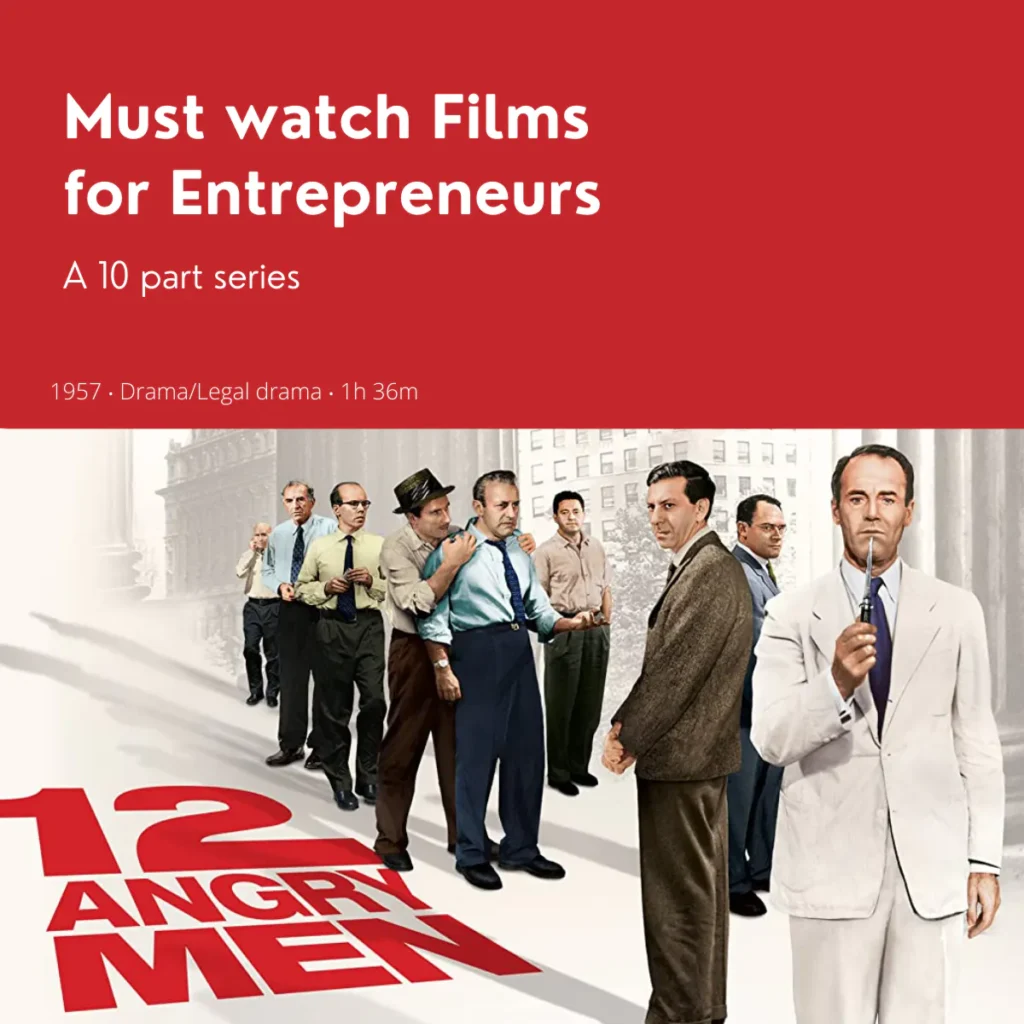
The academy award winning movie is not only one of the finest works of cinematographic art, it is also a master-class in negotiation and strategizing for budding entrepreneurs.
Watching 12 angry men is like taking a journey back in time: the brilliant writing, the remarkable direction and the amazing performances could beat hands down any movie released these days. Add to this the sheer modernism and progressive nature of the subject, and the ease with which it handles the complexities and subtleties of the characters, and you easily understand why 12 angry men is a movie that defies time.
While not enough can be said about the brilliance of 12 angry men as a movie, it is the insights it gives for the entrepreneur in you that I want to discuss.
Lets dive right in.
Premise
The movie starts in a courtroom: 12 men in a jury box have to decide whether an 18-year-old boy, accused of killing his father, should face the noose or not.
The jurors, sequestered inside the designated room, appear to have all already made their minds up about the guilt of the boy, and they take a preliminary vote, which feels more like a formality, a done deal.
All men vote guilty except one – Juror #8. The movie takes us through his efforts to convince the rest of the jury that there are things that have been overlooked, and the case might not be what they think.
- Initiative – Taking action, driving support
For the other jurors its an open and shut case. But juror #8 strongly feels otherwise. Knowing that the jury needs to reach a unanimous decision to reach a verdict and therefore a sentence, he decides to be the black sheep and deploy all the tricks in the book to convince the others that there is a chance that the boy might be innocent.
Once he has laid his opinion on the table, he realises that what he needs is the support of other people. He knows that people tend to conform to majority ideas even when they think differently. So, he applies a clever strategy: after speaking passionately about why he believes the boy should be given a chance, he calls for a secret voting. Was it a gamble? Maybe. But his true skill lay in knowing that there would be people secretly supporting him. And he was right.
2. Inquiry – Questioning, researching and verifying understanding
The boy was accused of killing his father using a switch blade knife that was, according to its seller, a rare and unique piece. The simple fact that the knife was recovered from the crime scene was enough for most jurors to be persuaded of the guilt of the boy. But Juror #8, not convinced about the uniqueness of the knife, walked around the boys neighbourhood and found one that looked exactly the same in another shop. When his fellow jurors used the theory of the knife as evidence of guilt, to their surprise, he tossed the identical looking knife right in front of them. Unlike others, he had done his homework. He questioned what was disguised as evidence, did his own research about possible scenarios and verified the information that was presented before him before believing it blindly. This forced more people to switch to his side.
3. Advocacy – Expressing convictions and championing ideas
Juror #8 made sure that every time he spoke, he did so with conviction and passion. He came across as polite most of the time, but did not hesitate to expose a fellow juror who was too angry and hellbent on sending the boy to the gallows. He described to his fellow jurors how the boy was abused all his life in an effort to appeal to their compassionate side. He reached out to people he felt were inclined to support him. He exhorted them to rise to reason and to maintain an open mind, but at the same, he wouldnt go about imposing his views on them. The kind of persuasion he showed got people thinking. It prompted one of the jurors to vote not guilty during the secret vote. The juror who supported him felt that if a person was willing to stand up against the entire group and face ridicule, then he must have had some important points to make.
4. Decision making – Evaluating resources, choices and consequences
As the jurors first convene inside the room to decide the fate of the boy, many do not seem to realise the magnitude of their task. They simply want to finish the matter at hand and disperse. But thats definitely not the way to reach a decision. Juror #8 takes them through various stages of decision making, asks them to widen their options, verify evidence presented, do away with stereotypical notions, recheck the situations presented before them, consider contexts, think logically and then reach a decision. He evaluates the arguments put forward by each of them and shows them why they dont stand or how they have glaring gaps. He makes them realise how critical their decision is, and the gravity of the consequences.
5. Conflict resolution – Confronting and resolving disagreements
Juror #8 starts off a conflict within a group that otherwise seemed unanimous. The conflict only grows as more people start switching to his side. Many a time the conflicts escalate and descend into chaos. But juror #1, the coordinator of the group, helped maintain the order and resolve arguments. In fact, different kinds of conflicts were resolved through different approaches. For example, when juror #8 voted not guilty, they tried to resolve the situation by giving everyone a chance to explain why they had voted the way they did.
6. Resilience – Dealing with problems, setbacks and failures
It was no easy feat for juror #8 to get 11 impatient and angry men on his side. But he was patient. He resorted to the idea that one of the other jurors called soft sell. He didnt say outright they were wrong; instead, he said he just wanted to talk about a few things and thus appealed to their curiosity. He did not impose his authority, but politely requested them to consider the facts he presented before them. A few defected to his side. This released the pressure on others to conform to the majority. No matter how hard some of them would come on to him, he stood his ground and remained persuasive. His resilience paid off eventually.
7. Critique – Delivering objective, candid feedback
Juror #8 had only one objective: to convince others that they might be wrong about the boy. This was possible only through evaluating the whole case once again and assessing the evidence and witnesses presented during the trial. His first step was to be candid about what he thinks despite opposition from a majority. Once he put his opinion out there, his job was to handhold the others through the process. He started reasoning. He used clear examples to convince his fellow jurors, like the fact that an old man with an ailing leg could not possibly reach the front door of his bedroom in 15 seconds to see the boy running away after supposedly killing his father, or that it was unlikely for the witness to have heard the boy shouting Im going to kill you when a noisy elevated train was passing by, or it was improbable that the neighbour lady with a failing vision could, from her apartment, see the boy committing the heinous act. This process worked and soon, even some of his fellow jurors came forward with additional logical arguments. Together they started finding things that were missed out during the trial. One by one, he won them all over by questioning them, by laying down facts and by pointing out loopholes in the testimonies. At the end of it all, the dynamics in the group changed entirely, and all 12 men vote in unanimity that the boy was not guilty.