
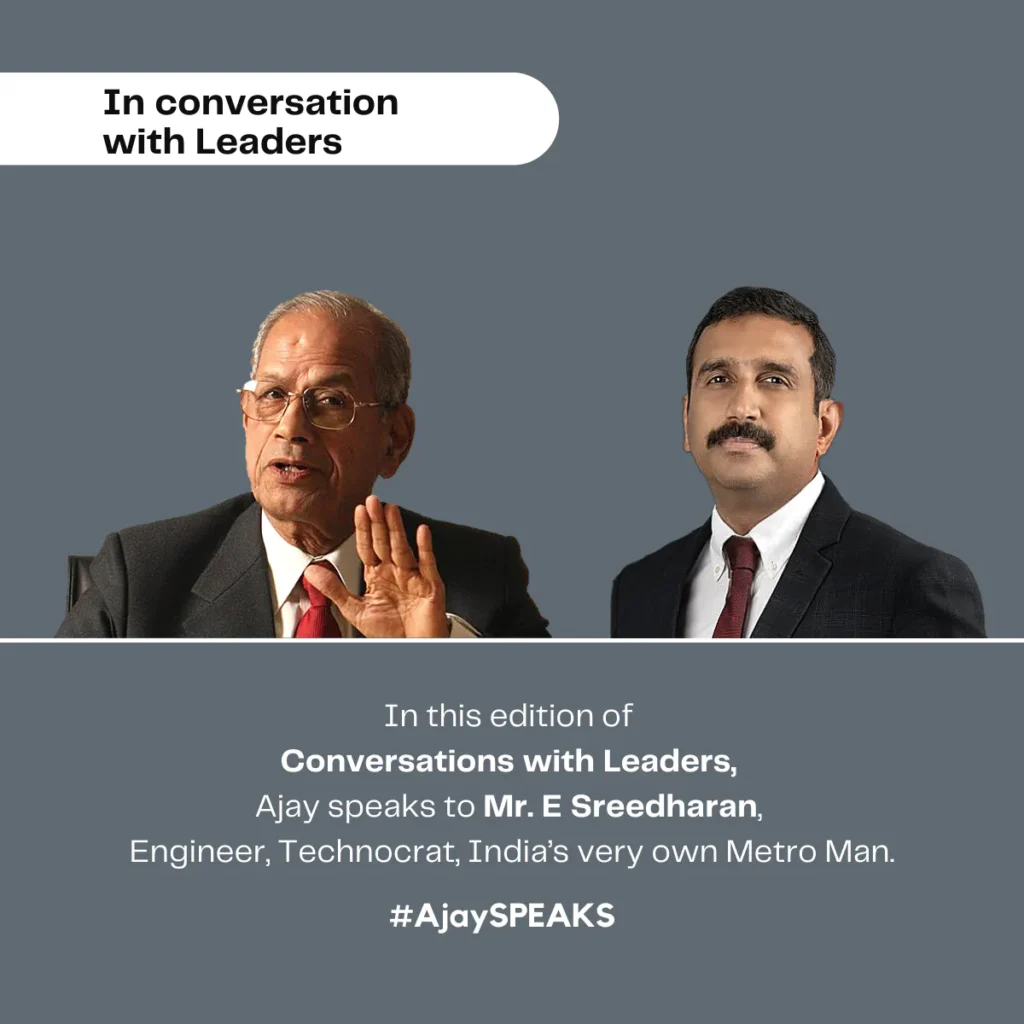
When you get to talk to a visionary and technocrat like E Sreedharan, you will never run out of things to ask. Mr. Sreedharan, a Padma Vibhushan awardee, ushered in revolutions in Indias public transport by building the Konkan railway, which was thought of as the closest thing to impossible, and completing the work of Delhi Metro Rail in record time. Here is an edited version of the conversation I had with Mr. E Sreedharan, engineer, technocrat, Indias very own Metro Man
Ajay: Its not often that an engineer or a technocrat becomes a common name in every conversation, a name people revere. Your name came into the limelight like a whiff of that much-needed fresh air, breaking the notions around the red-tapism and inefficiency of the system. For people who always sought a super-hero, you became the Metro Man. Im curious to understand, what is your philosophy around success?
E Sreedharan: I believe success is the result of hard work, domain competence, leadership abilities and performing ones duties without expecting any personal gains or rewards.
Ajay: Cant agree with you more. Speaking of domain competence, if you were to distil down the three must-haves to be an expert and the best in ones field, what would those be?
E Sreedharan: I would say integrity, professional competence, and sincerity and commitment.
Ajay: We have seen how you have practised those values in real life. With that as your mantra, you have delivered successful projects one after the other. But whats your process/model behind consistently, repeatedly delivering great results on all projects you undertake?
E Sreedharan: The inspiration that you are working for the nation. If you are not an expert in the field engage an expert to assist you. Be determined to complete the project on time and within the estimate. Build a capable team whom you can trust, and simplify the decision-making process. The success of a project lies in the success of the contractors and suppliers engaged. They should never be allowed to fail.
Ajay: Yes. Its always a team effort. That sense of being a team committed to one single goal is of paramount importance. As a leader, how do you instill that strong commitment among employees who work even at the bottom-most level of the hierarchy?
E Sreedharan: One has to set an example to the rest of the employees by being a role model.
Ajay: True. But during my career, what I have often seen is that it comes easy for people to talk about being a role model and instilling values in others. But when it comes to walking the talk, most of them fumble. In that sense, you are an exception. You stand out by having successfully practised what you have preached. I would like to hear more about how you managed to instil the right values in your team.
E Sreedharan: Before starting a project, its mission and steps to achieve the mission should be very clear and be made known to every individual in the team. There should be periodical interactions at various levels in the team regarding the style of implementation. I used to have a practice of interacting with the senior leaders every Monday at 9 AM. Similar interactions with middle-level managers used to take place on the first Monday of every month. These meetings used to be very informal and without an agenda. Minutes of such meetings were not recorded. Thus I could reach almost every individual in the organisation and convey the values and qualities they should cultivate to succeed.
Ajay: Fascinating. The power of communication cannot be emphasized enough. Now, this may sound slightly off-topic. But what do you think the role of parents is in making our youth future-ready?
E Sreedharan: Parents play a very dominant role in this matter in terms of instilling ethics, values and principles in their children. But what I consider more important is the need for quality education to be provided at all levels – starting right from school to college to all the way up to higher educational institutions. It has to have continuity. In Japan when a child goes to school, in the first two years, they are taught only manners, values and social responsibilities. The academics start thereafter only.
Ajay: Enlightening! I concur that such an educational system would create wonders by creating a crop of young individuals who are true to their values. If I can add to that, confidence, self-esteem and philosophical roots are the three values that are considered to be significantly important in enhancing the performance of a person. I believe exposing the youngsters to their tradition, history and the richness of their culture would help them gain in these aspects. How do you think the youth across the globe can be provided with this kind of an exposure?
E Sreedharan: The performance of a person is directly related to the values and principles embedded in him/her. These have to be passed on to them partly at home and mostly in educational situations. Education should not be limited to objective matters such as physics, chemistry, engineering, etc. Instead, it should empower an individual to know the self within him/her and what resources he/she can draw from ones own self. Unfortunately, our educational system till now has failed to address the latter part.
Ajay: I sincerely hope policymakers across the globe take a leaf out of your example and do the needful. Im sure what awaits us is a promising future after people like you have shown the way.